How The Tiger Opened His Third Eye

To listen on YouTube, click here.

Once upon a time, in the very far East, there was a tiger who lived in a jungle beside an ancient temple. 

Every day, resting in the striped shadow of a palm frond, the tiger watched the monks at the temple as they went about their business. 

The monks swept the floor of the temple clean with grass brooms.

They polished the statues, offering little prayers as they worked.  

The monks lit candles and incense that filled the temple air with fragrant smoke. 

And then, after chanting a word that means “peace,” the monks sat down to meditate with great concentration for a very long time.

The tiger squinted his eyes and yawned, and his great fangs glinted in the summer sun. 

He wondered what the monks were thinking about while they meditated. 

So, after the monks finished meditating and prepared their simple, meatless dinners of lentils and rice, the tiger crept closer to the temple and listened to the monks talking. 

One of the monks seemed to be in charge, and the other monks listened to him intently as he spoke. 

The tiger noticed that some light-skinned strangers who were wearing unusual garments had arrived to visit the monks and hear them speak.

The monk who seemed to be in charge spoke about the importance of peace and non-violence. 

All of the monks nodded quietly, and the strangers nodded too. 

Then, he spoke about enlightenment.

And all of the monks nodded quietly, and the strangers nodded too. 

And then, the most important monk said something in passing about “opening a third eye.”

All of the monks nodded quietly, but the strangers seemed to get very excited. 

And the tiger got very excited, too. 

The tiger returned to the jungle, thinking about non-violence and this third eye. 

“I want a third eye,” thought the tiger. 

“If I had a third eye,” he thought, “imagine what I could see!”

But then, something occurred to the tiger that troubled him. 

All of these monks were peaceful and they ate a plant-based diet and they meditated every day for many long hours, but even the most important monk only had two eyes. 

The tiger shook his head.

“If these monks work so hard every day and they still only have two eyes, how can I expect my third eye to open?”

And then, the tiger chuckled to himself. The answer was so simple. 

“The monks are only people,” the tiger realized, “but I am a tiger, and tigers are grrrreat.”

So it was at that moment, as the sun set behind the ancient temple, that the tiger began his meditation. 

He meditated all night, and the moonlight cast striped shadows over him through the fronds of palm trees as they moved gently in the breeze. 

When the monks rose the next morning, the tiger was still meditating.

“See,” he thought, “I am already ahead of them.” 

The tiger meditated on peace and non-violence, but he found it very difficult to meditate on the absence of a thing. 

“What is peace,” he wondered, “but the absence of violence?” 

“What character does peace have unto itself?”

“It seems as though peace is an empty space or a pregnant pause — an ellipsis…”

“Now I am getting too philosophical,” smiled the tiger. 

“I need to try harder.” 

After many hours of meditation, the tiger felt thirsty, and he made his way down to a stream. 

He drank his fill of water and listened to the conversations of the birds as they flew from branch to branch above him, looking for insects and worms to kill and eat. 

“Two-eyed savages,” he sniffed. “They’ll never reach enlightenment.” 

But just then, he saw movement downstream as the dense foliage rustled. 

A spotted deer poked out its head, looking around to see if it was safe to drink some water. 

The tiger was hungry, and he licked his lips. 

Normally, he would begin stalking the spotted deer — waiting for the perfect moment to pounce.

Then he would sink his teeth into its neck, as blood splashed onto his fur, and crush its windpipe. 

He would pressure the deer down to the ground with his weight and hold it firmly until it succumbed to darkness. 

Then he would drag it to a secluded spot and tear it open, digging out its warm liver and kidneys — all of the good stuff, first. 

“My,” sighed the tiger, “thinking about this is making me awfully hungry. I had better stop. I will never reach enlightenment this way.” 

So the tiger turned around and walked into the jungle until he could no longer see the deer.

Then he tried to chew on some leaves. They were pretty disgusting, but he kept at it. 

“I just have to get used to it,” decided the tiger. 

He tried digging up some plant roots because he had seen men do that, but the roots were very dirty, and they didn’t taste very good. 

Then, the tiger returned to his spot under the palm fronds and resumed his meditation. 


This went on for several days. 

During breaks from his meditation, the tiger tried eating all kinds of plants. 

He choked on various grasses and leaves and even flowers. 

After watching the monkeys, he decided to try some bananas, and the tiger had to admit that bananas were not bad. 

Still, no matter how many bananas he ate, the tiger remained hungry. 

And he started to feel very sick, and very tired, and very weak. 

And it was very difficult for the tiger to concentrate during his meditations. 

Then, one afternoon, as he was feeling perfectly awful, the tiger had an idea. 

“The monks don’t eat grass and bananas,” he thought, “they eat fluffy white rice!”

“Maybe rice is the secret.”

“I know where the rice grows, but I don’t know how to make it fluffy.”

“I should go get some of the fluffy rice.”

The tiger was certain that this was the solution.

So he returned to his meditation and waited until after the monks had eaten their meal. 

After the stars appeared in the blue-black sky, the tiger crept toward the temple through the shadows cast by the moonlight.

Quiet as a kitten, he snuck into the temple kitchen and carefully rummaged for leftover rice.

He found a few grains of fluffy rice on the floor, but the monks had cleaned their pots and bowls. 

The tiger became very upset. 

He was SO hungry.

Just then, he heard movement outside the kitchen, and the tiger quickly hid in the shadow behind the open door. 

One of the monks walked in, carrying a lantern to light his way. 

The monk looked around the room.

And it was at that moment that the tiger’s hunger overcame him.

He lept out from the shadows and pounced upon the monk, who screamed and dropped his lantern, which smashed on the floor. 

The tiger sunk his teeth into the monk’s neck and ripped the skin open.

Warm red blood sprayed out of the monk with each beat of his panicked heart. 

The tiger shook the monk violently and crushed him down to the temple floor.

And as the monk struggled to take his last, coughing breaths — the tiger ROARED.

The fire from the lamp had spread and the growing blaze lit the room with a wild flickering light. 

Other monks appeared and shouted and ran away, but the tiger stayed, gorging himself on the monk’s still-moving meat. 

The hungry tiger ate and ate and he had never felt more alive and he wasn’t sorry or sad because, after all, he was a tiger.

The tiger had forgotten about his quest for enlightenment. 

But then, some men from the village appeared at the door of the flaming kitchen — and they were armed with guns.

The men shouted, and one of them shot at the tiger, and a bullet grazed his shoulder.

“OWWWWWWWWWWWWWRRRRRRR,” the tiger roared. 

The tiger jumped up quickly and ran out of the kitchen through the other door.

“Now these men are trying to kill ME!” 

The tiger ran back toward the jungle, away from the burning temple. . 

The men chased him, firing their guns.

Bullets smashed into the trees and sent bark shrapnel flying past the tiger.

But tigers run faster than men, and the tiger disappeared deep, deep, deep into the darkness of the jungle.


Exhausted but no longer hungry, the tiger sat down to meditate once more. 

His wound was still bleeding, but not much, and it didn’t really hurt. 

But the tiger was frustrated and confused. 

A monkey swung down near him — but safely out of reach. 

He stared at the tiger, and seemed curious or possibly concerned. 

So the tiger told the monkey what had happened. 

The tiger told the monkey how he had tried to meditate upon peace and non-violence like the monks, and how the monks refused to eat meat, so he also refused to eat meat, because the monks seemed very wise. 

The tiger told the monkey that he was trying to find enlightenment, and the monkey rolled his eyes. 

The tiger grrrrrumbled, and he said to the monkey, “You know, it’s strange. The monks preach non-violence and it is true that they remained peaceful. 

But it is also true, you see, that those peaceful monks had no problem fetching the men from the village to use violence against me.” 

And, at that, the monkey shrugged and swung back up into the tree. 

Some leaves fell from the branches above, and the tired tiger’s eyes followed one of them as it floated lazily to the ground. 

When he looked up again, the jungle was transformed.

Everything around him appeared as if in a dream — depths were uncertain and the jungle sparkled with prismatic light. 

The air itself seemed as though it were alive. 

And that is when the Great Tiger revealed himself. 

The Great One looked down at him with a thousand piercing eyes and unfolded a thousand paws.

He was resplendent in stripes of every color, and The Great Tiger was everywhere all at once—beautiful and terrifying. 

The Great One roared in a roar that came from all sides, and the tiger could feel his bones rattle inside him. 

And then, the Great One spoke to him calmly in a voice that felt as though it had come from the beginning of time and moved through our tiger toward the distant and unknowable end of all things. 

The Great One said:

“You will not find what you seek in that burning temple. 

Those monks live in error. 

They are able to remain peaceful only because they are protected by the men of the village. 

They may seem wise, but they are delicate cubs looked after by a ferocious mother. 

I will tell you about violence. 

Violence is a form of energy — it can be neither created nor destroyed. 

It moves from one creature to another, changing state and form, but peace—true peace in life—is an illusion. 

A whispered trick of the dragon. 

The only true peace comes in death, and even death provides for the living, and the violence continues. 

The worm feeds on death’s decay, growing fat until the peaceful dove brings death from above, snatching it from the soil, and swallowing it whole. 

And when the eagle catches sight of the dove, he strikes like lightning — crushing it in his talons. 

The wild grass draws life from death and waste, and the deer feed on that grass.

But, as you have discovered, tigers do not feed on grass. 

It is the role of tigers to feed on deer.

You see, the monks in your temple teach peace, but reality has not changed to accommodate their delusion. 

They discovered that prayers and incense alone will not dissuade hungry tigers from eating them. 

Men can only keep tigers away by threatening them with violence. 

And the world of men works the same way. 

The monks in the temple pray for peace, but peace is only achieved in the world of men when one group of men becomes so powerful through wealth or valor that they make rules against violence which can only be enforced by the threat of violence.

So peace, to the extent that it exists at all, is the product of violence. 

The threat of violence is the gold standard which guarantees that the laws will be obeyed, and that tigers will not invade the temples and villages of men. 

Violence is neither good nor is it evil. It simply is. 

Violence is an ocean in which one can swim or drown. 

Violence is not a god to be worshipped but a fundamental reality of the universe, a constant that one must recognize and respect if one is to achieve true enlightenment. 

The tiger listened to the Great One and contemplated His words of wisdom… 

He took a deep breath and felt something tingle in the center of his forehead.

And then, like a flower unfolding to greet the morning sun, the tiger’s Third Eye opened. 

And when the tiger’s Third Eye opened, he found that he could see the world just as before, but with greater clarity and understanding. 

He sensed three words forming between his black lips and his barbed tongue, and he whispered:

“Violence is golden.” 

The meditating tiger returned to all fours, surveying the jungle as the first rays of sunlight penetrated the morning mist, and he said out loud—to no one in particular:

“I wonder where that deer went.”

And the tiger started his day. 

And that, friends, is the story of how the tiger opened his Third Eye. 


This fable is a mythic re-imagining of the essay “Violence is Golden.”

Read my all-time most widely-read essay here to explore the concept in greater depth. 
Read more

Ian Smith – On Manhood and Resistance

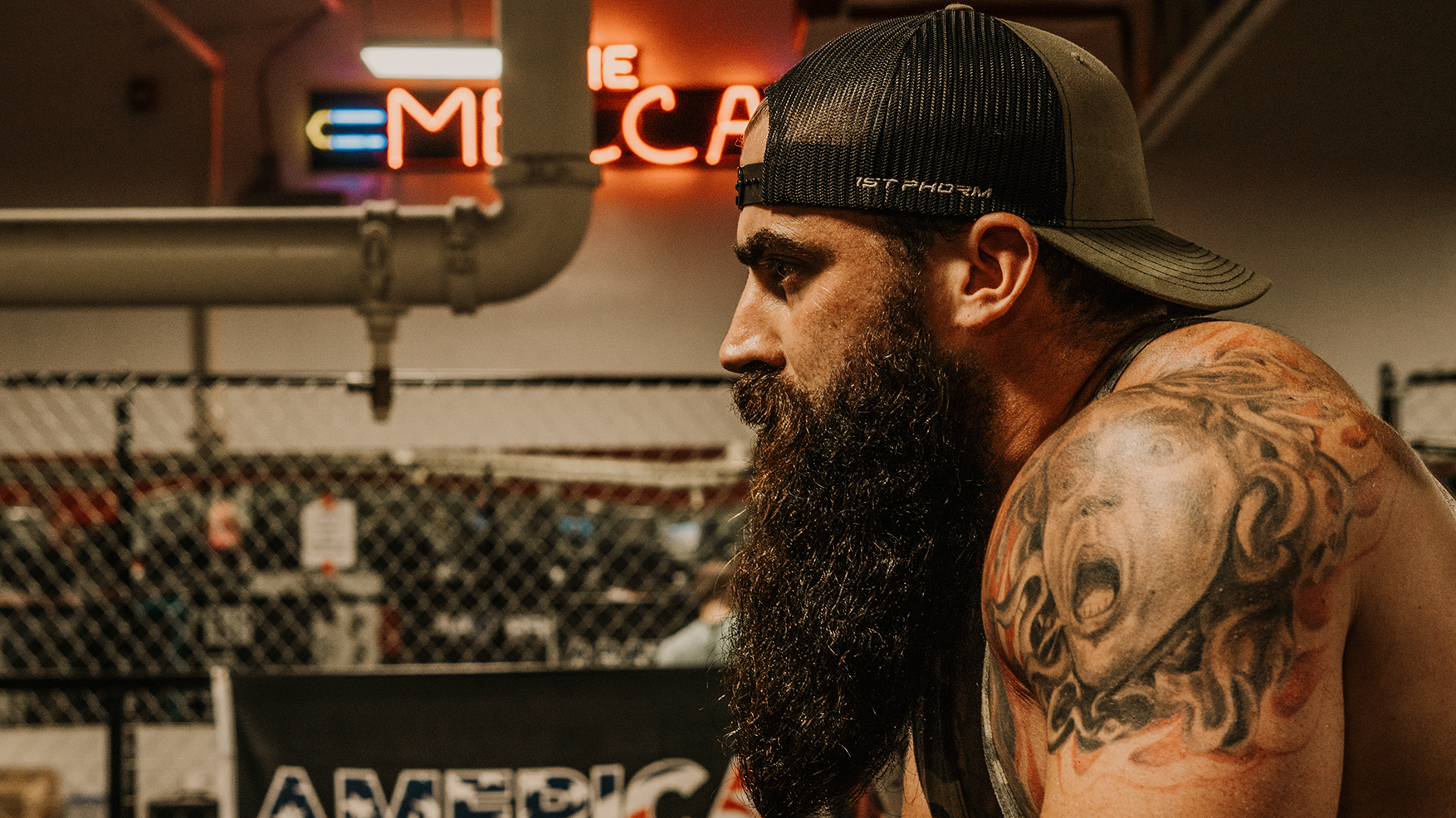
Ian Smith photographed by Jack Donovan. 2021. 

This interview was published online as part of the CHEST magazine project in 2021. 

Early in the 2020 lockdown, as governors were ordering businesses to close and free American citizens to “stay at home,” Ian Smith and his business partner Frank Trumbetti reopened their Atilis Gym in Bellmawr, New Jersey. Over the following weeks and months, they were arrested, cited, and fined $15,000 a day. When officials boarded up their front doors, they kicked the boards down and reopened for business. 

Over the next year, the fines and charges continued to rack up. Still, Smith and Trumbetti remained steadfast, and their courageous defiance inspired frustrated business owners and indignant Americans all across the country. They saw Smith on the news and online defying state orders and engaging in legal battles with the Governor of New Jersey, and many said to themselves and their friends, “Finally. Someone is doing something.” 

Smith and Trumbetti were able to continue their fight and keep their gym doors open because hundreds of thousands of people donated online and bought the t-shirts that read “BELLMAWR FOR EVERYBODY.”

I don’t believe we should use the word “hero” lightly, but I also think that something is lacking in us as men if we are afraid to use it all. We should never allow ourselves to become so insecure or self-centered that we can’t look at another man’s actions and applaud them and say, “this is the way.” 

What is a hero, if not a man who stands up against evil, corruption, and tyranny when no one else will? 

A hero does what other men want to do but are afraid to do. 

And by doing that, he becomes an exemplar. 

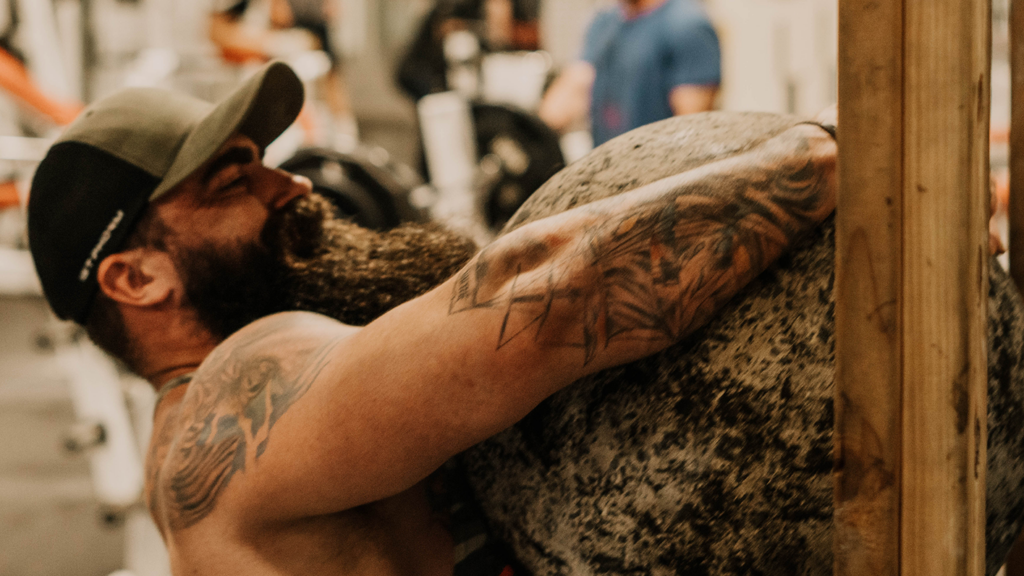
Ian Smith lifting stones photographed by Jack Donovan

Heroes aren’t perfect, and we should never expect them to be. They’re human, though the ancients often attributed them with divine parentage. People often forget that even Herakles performed his famous labors to atone for a streak of madness that caused him to murder his whole family. 

Heroes are the flawed men who happen to show up when needed most to do battle with chthonic darkness and the serpentine servants of the void. They show up to slay the dragon. Or at least — they show up and give it a shot. 

Smith and Trumbetti went to war with the leviathan of the state, and the state went to war with them. At one point, the New Jersey governor seized over a hundred thousand dollars in donations from one of their bank accounts. Smith has become a targeted man, navigating multiple social media bans and shadowbans. 

He’s also found himself a man sought after as a public speaker. He spoke at the Conservative Political Action Conference (CPAC) this year — though that trip also got him officially banned from American Airlines for refusing to wear a mask on the plane. Smith documents his experiences with the TSA when he flies now, as he is now flagged for approximately three hours of harassment every time he attempts to board a plane. 

I did a podcast with Ian a few months ago, and I posted it to Rumble — because YouTube would have surely shut down my account if I’d posted it there. However, after realizing that Bellmawr was so close to Philadelphia, I decided to visit the famous gym and interview him for CHEST. 

My folks live in Pennsylvania, so I planned a visit home and made the trip out to Bellmawr a father-son outing. I drag my dad along on these East Coast adventures every so often, and he gets a kick out of it. 

Early in July, we drove across the Delaware River on the pale green Walt Whitman Bridge and headed through suburban Bellmawr to the Atilis Gym. My dad and I walked in the front door and were asked to get a temperature scan and fill out short statements about our current health status. Then Ian appeared at the counter with his Mesopotamian beard and showed me around the gym. 

The front area was packed with t-shirts, and as I walked out onto the busy gym floor, I noticed that almost everyone there was wearing some version of the BELLMAWR FOR EVERYBODY shirt. (I had mine on, too.) The community had really come together to support the gym. I also noticed that it was a serious gym — to an extent I hadn’t expected — outfitted with tons of heavy-duty bodybuilding and powerlifting equipment. There were some massive guys walking around. There’s also a martial arts area upstairs, which Ian plans to expand. 

After touring the gym, Ian introduced me briefly to Trumbetti, and then we headed into the office to talk. Above us, a framed print featured the Teddy Roosevelt quote from his speech about “The Man in the Arena.”

“It is not the critic who counts; not the man who points out how the strong man stumbles, or where the doer of deeds could have done them better. The credit belongs to the man who is actually in the arena, whose face is marred by dust and sweat and blood; who strives valiantly; who errs, who comes short again and again, because there is no effort without error and shortcoming; but who does actually strive to do the deeds; who knows great enthusiasms, the great devotions; who spends himself in a worthy cause; who at the best knows in the end the triumph of high achievement, and who at the worst, if he fails, at least fails while daring greatly, so that his place shall never be with those cold and timid souls who neither know victory nor defeat.” 

My dad had asked me what Ian did before he owned a gym or became a public figure — and I didn’t know the answer myself — so we started there. 

Based on the way Ian looks now, many people would assume that he was a jock in high school who has always been some kind of meathead. But, much like Teddy Roosevelt, he describes himself as having been a “feeble kid” with asthma who didn’t want to play sports, didn’t want to be challenged, and just wanted to blend in. He went to college, where he studied some math and some physics, and then eventually philosophy. 

One morning, after waking up from a late night of college drinking and then “driving like an asshole” (his words), he ran a stop sign. He ended up killing a man with his vehicle. Ian himself ended up halfway through his windshield, and the officers on the scene told him that as they approached the wreckage, they weren’t expecting to see a survivor. There was still alcohol in his system from the night before, so he was charged with a DUI and spent several years in prison. 

Ian said that it was surviving this accident that sparked his interest in strength and health. 

“I hadn’t appreciated anything about what my body was capable of. That’s where I got into strength training, because once I started it was a way for me to channel all of my bullshit into something that I could create and that I had control over and that nobody could take away from me. Especially as I got into prison — you know, they take everything. They take your name, they take your self-expression, they take your ability to communicate. When to eat, when to shit, when to sleep, who to sleep next to — whatever. And that was something that kept me sane through all of it because, no matter what, I could work on this tangible project that nobody could take from me. I remember being in solitary confinement doing 10,000 pushups a day because it was just me in a cell. […] I’ve dabbled elsewhere, but nothing ever caught my attention like strength training did. I’m fascinated by what you can do when you put hard work with a little bit of planning and repetition — it’s incredible what people could do.”

Fast forward through hard time and an ill-fated marriage in Arizona. Ian found himself deep in debt from a divorce, and he moved home to New Jersey and started training people “with the kind of weights you buy at TJ Maxx” out of the back of his car. Eventually, he built up a clientele and started renting space from his future business partner Frank, who had owned a supplement shop for twenty-five years. Their businesses kept growing, and Smith put everything he made back into his own operation until the two of them eventually had an opportunity to buy Atilis. 

Frank and Ian opened Atilis nine months before the flu shutdown. 

Ian said that training people is his passion, and while he still manages to do some training, he’s looking forward to spending more time doing it once they get to start operating like a real gym again, instead of “Fort Bellmawr, The Resistance.” 

Ian and Frank always saw eye-to-eye on what they wanted Atilis to become.

“We wanted to create a place where everybody — no matter what you were doing — everybody is united by the theme that you’re in here busting your ass. And that you’re supporting one another and learning from one another. We wanted to have a gym where, when you walk in, not a lot of people have headphones in. People are talking to each other and looking at each other and learning. It’s not just where you go and do your daily chore of working out, but a place where you really come to enjoy the atmosphere. A dumbbell weighs the same wherever you go — but that’s why you want to choose this gym.”

I asked him how it was for him, moving from being a “guy training out of his car” to a “guy who is on CNN.” 

He said that one of the hardest parts has been dealing with the reality that while he’s “never claimed to be a saint,” everyone automatically assumes that you do when you become a public figure. People also start to look to you for advice and direction, which comes with a lot of responsibility. “Now I’ve developed this platform that is like a tool — and you can do whatever you want with it. You can be a total asshole, or you can be a saint, or you can be somewhere in the middle, which,” he laughed, “is kinda where I like to be.”

Ian credits speaker and author Andy Frisella with helping guide him through some of the challenges of being in the public eye for the first time. He also said he looks to Sean Whalen because he “gets a lot of flack,” and Ian looks to both of them to figure out “how to not stumble and fall on your face.” But it is important to Ian that people know how much he has learned from his business partner, Frank Trumbetti. The two of them have faced all of the same risks and challenges together, and Ian says that Frank taught him a lot about following through and, as he put it, “just shut up and work.” According to Smith, Trumbetti has been unshakable, working tirelessly, day-in and day-out to keep the gym running — setting the standard for both of them. Ian credits Frank with teaching him that perseverance and hard work are what make success possible.

Smith said that staying in the public eye has been what saved the gym — because he and Trumbetti could never have fought what he calls a “war of attrition” with the State of New Jersey without all of the public support.

The gym, by the way, has been free to the public for months. It survives entirely on the support of people in the area and across the United States. 

 “If you do the right thing, people will support you. Everybody’s so afraid to do the right thing because it’s hard and because it’s uncomfortable.”

“Without the amount of support we’ve gotten over the past year or so, whether it be support for me and the gym or the gym, we would have been up shit’s creek. We still are, but we’ve got paddles.”

At the time we did this interview, everything had pretty much opened back up in most parts of the country. I asked Smith what he was going to do and how he was planning to use his platform now that people were back in gyms and attention was moving to other issues. 

He said that he had been thinking a lot about that and had been trying to determine what was most important to him. 

“Through this, I’ve seen the weakness of men. It’s so hard to ignore, and it’s snowballing. I feel like I’m watching a train wreck. At the end of the day, I know who I am. I’m a man who has certain values and principles, and I think they are good ones. So I want to help other men find their own. Not necessarily mine. But to be able to explore what it really means to be a man. Because in today’s world, I think that is something that most men — or far too many — don’t ever get to explore.”

 “I don’t think it’s a question that many men ask themselves these days. Like, ‘Who am I? What’s important to me? What am I willing to fight for? What am I willing to let go?”

He says he gets thousands of messages every day, and many of them are women thanking him for being a strong man and telling him how they want their sons to grow up like him. Then he laughed, “No, you don’t — just ask my mom.”

“I’m still figuring out how to be a man myself, but there’s just not enough of that these days.”

It’s important to Ian that men develop the ability to, “persevere and be ‘tough’ — and that doesn’t mean fighting, that means flourishing in a world that will crush you if you don’t do something about it. Living to the greatest extent of what you can be and what you want to be — what you truly want to be.”

We talked for awhile about the cycle of comfort that creates softness in men until things fall apart and then forces men to create order from chaos again — though we both agreed that we really donwant to watch it all collapse or go “Madmax.” 

Ian dreams of a society in which men understand the dangers of the cycle and understand that it is our duty to protect that order and teach the next generation how important it is to protect that order. 

“So the good times keep rolling” and we “don’t get so distracted by the pleasures of the good times to remember that we’re always just a couple steps away from losing this. If you ask me what’s most important to me, that’s it. I don’t want to see it all burn. I want to see us all grow. All of us.”

When we conducted this interview, it seemed as though Smith might actually get to go back to training people and operating a normal gym and begin moving into a role as a speaker and mentor for men. However, over the past few weeks, the corrupt authoritarians seem to have convinced the most gullible, fearful, and compliant parts of the population that the first in what seems likely be an endless parade of flu “variants” is a major threat. 

Some Australians are already operating under martial law. In America, Red states seem less likely to go back to mask mandates and lockdowns, and some — like Texas and Florida — have enacted legislation banning them. But New Jersey is a Democratic state, and there’s a strong chance that Smith and Trumbetti may be forced to step back into the arena and “Fort Bellmawr” at Atilis may continue to be a symbol of freedom and resistance. 

Read more

Aubrey Huff – Alpha American

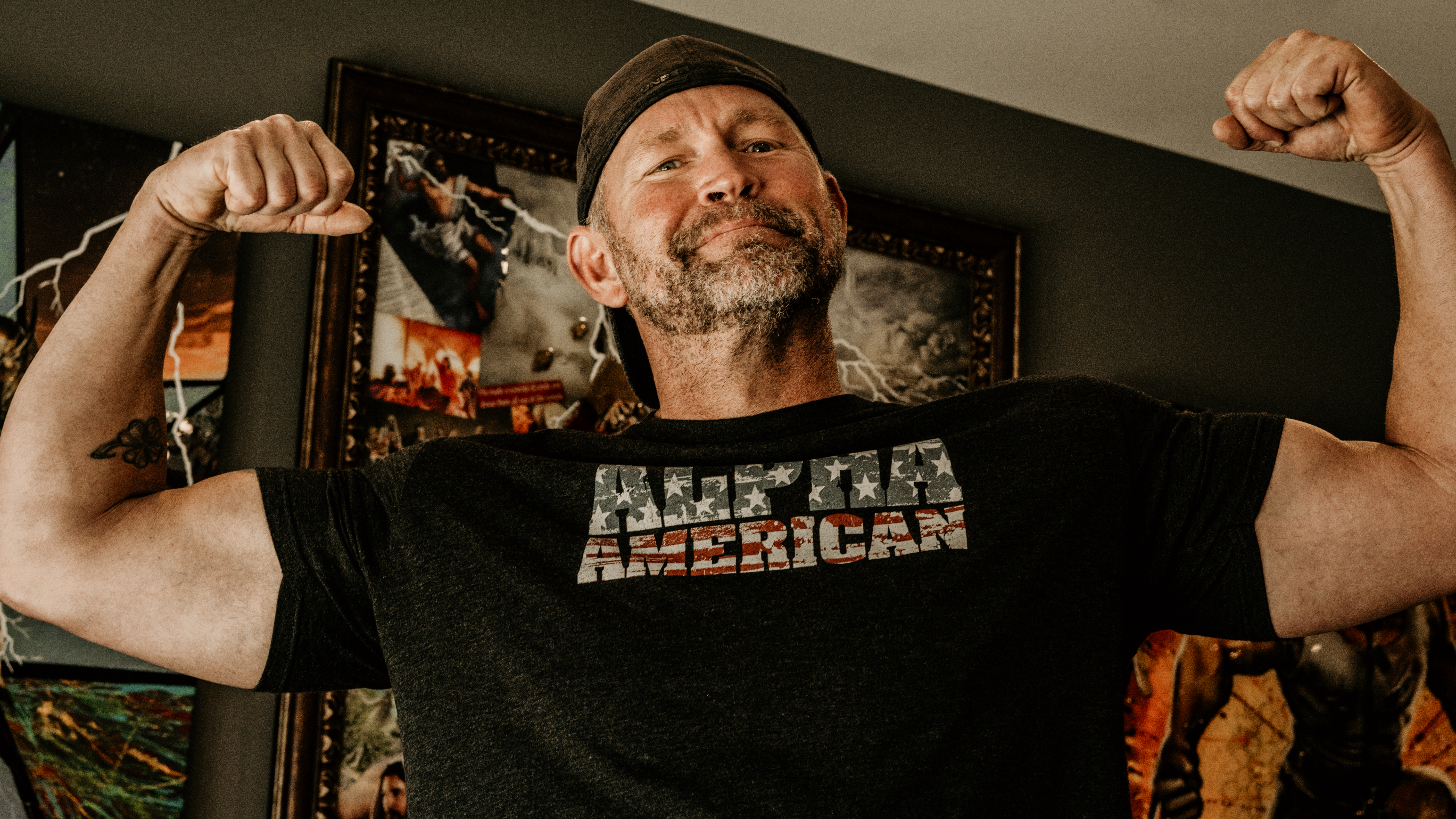
Aubrey Huff photographed by Jack Donovan. 2021. 

This interview was originally published online in 2021 as part of the Chest Magazine project. 

Aubrey Huff wants to be a good father to his sons. He wants to set an example for them.

He wants to show them what it means to be a man, and what it means to be an American.

Lately, he’s been selling t-shirts through his patriotic brand, Alpha American . As an outspoken advocate for both freedom and masculinity, he’s had his verified accounts banned on both Twitter and Instagram.

But if you knew about Aubrey Huff before all of that — you knew him from baseball. Huff played 13 seasons in Major League Baseball. He finished his career with the Giants, and won two World Series with them. He loved being part of that team and speaks fondly of those times and told me that he still keeps in touch with some of his teammates. However, as a Trump supporter and masculinity advocate, the San Francisco-based Giants organization has tried on several occasions to distance itself from him.

Huff reached out to me after reading The Way of Men , and after watching the big tech establishment collude with political organizations to target and silence outspoken voices like his, I decided to fly out to San Diego to interview him for CHEST. As a former Major League Baseball star, Aubrey Huff is a well-known, mainstream figure who is remembered and appreciated by millions of baseball fans across America, but he presents as a friendly, down-to-earth guy who could just as easily be a general contractor. I brought the guy I live with along with me, because he is a lifelong Giants fan, and Aubrey happily offered him a baseball card from his drawer and signed a Giants baseball for him. We sat down at Huff’s kitchen island to talk about his past, the present state of masculinity, and the future of America.

I’ve noticed over the years that there is a tendency and even a strong desire among many to believe that particularly masculine or accomplished men simply emerged from the womb or from the smoke from some lightning strike exactly as are now or as they were in their prime. We want our heroes to be divine and there was a tendency even in the ancient world to mythologize the lives and even the childhoods of men who rose to prominence or who did great deeds. Many women and homosexual men want the truly masculine man to be some alien “other” who is and has always been unshakably confident, firm, and certain. They want to believe that he simply “is” and that he never had to create the man that they see before them from some confused or hesitant boy.

It is also true that men want to believe that the men who they follow are special and gifted. The word hierarchy itself essentially means holy order, or rule by the divine order. When someone’s at the top of the hierarchy, we want to believe that there’s some magical reason why.

While there has always been a desire to believe that these men are some kind of supernatural “other,” I believe that the reality of their personal transformations is far more inspiring. While some men do seem to be guided into a confident masculinity by strong father figures, and I believe that’s how it should be, many of the most vocal advocates for masculinity are men who corrected something that they found lacking in themselves. They create a light in response to an internal void or perceived void. Their confidence is a response to self-doubt. We could call it the “Roosevelt Effect,” after Theodore, and it came up recently in my interview with Ian Smith, who described himself as a “feeble” kid who avoided challenges. Detractors would say that they are motivated by “insecurity,” but I’m inclined to wonder in response what motivates the kind of people who would say that, and indeed, what their preferred motivator might be. Many of the men I’ve met who have achieved something notable have confided that they’ve always felt they had “something to prove” in some way or other.

Aubrey Huff — who grew up to become a successful Major League Baseball player and one of the few well-known men today who is risking revenue and reputation to stand up against big tech — that guy told me that once upon a time, he thought of himself as a “mama’s boy.” Aubrey’s father was murdered while trying to stop a domestic dispute as a bystander in Texas when Huff was only 6 years old. He and his sister were raised by his hard-working mother, who encouraged them in athletics. Still, growing up without a father, Huff told me that he was uncertain and lacked confidence and didn’t even manage to find a girlfriend until he was in college. When he made it to the major leagues, he said, he had to “grow up quick.”

Huff said he learned a lot about being a man “in the clubhouse,” which taught him about leadership and building relationships and learning how to work together with other men as part of a team. He said it’s something that he missed a lot after he retired, and we compared it to some of the challenges men face when they leave the military and lose that kind of camaraderie — though Aubrey was quick to point out that “those guys are heroes” and that he was just “playing a kid’s game.”

Huff said his marriage and divorce also taught him a lot about being a man. When he was playing baseball in the major leagues, he had that alpha energy and that’s what his wife signed up for. When he retired, though, he decided to encourage his wife to “go pursue her dreams” and he stayed home to “cook and clean and do the shopping and take the kids to school and fold the laundry.” He did that for a few years, and said that he felt,”like a caged lion.” He went through some depression, and even though he was doing what progressive society says that men should do, he wife was less attracted to him. Eventually, they drifted apart, and he says that, looking back, he blames himself for allowing himself to become a “beta male.”

“She signed up for an alpha male.”

He said he did a lot of research into men’s books and referenced Rollo Tomassi and Richard Cooper.

“Kill the beta before it kills you.”

As he came to understand what happened, he realized that helping other men understand that became part of his mission.

“Don’t allow yourself to become feminized by this pussified society that is trying to assassinate men’s character and their strength.”

Huff’s boys are in public school now, and that’s where he sees a lot of the programming start. He tells his kids to listen to their teachers when they are talking about math or science, but when they start to spew their “political bullshit” or tell them that they’re being “too aggressive or competitive, I want you to pretend like they are the Charlie Brown teacher. ‘Wah-wah-wah-wah-wah.’”

“I talk to my sons like they’re men. I don’t tell them that the world is full of puppy dogs and ice cream, because it’s not. You’re not a special snowflake. The world’s not going to be fair. But when you figure out what your gift is and what you want to do — I don’t care what it is — you go out and do it with everything you have. At the end of the day, you can lay your head down knowing that you did your best.”

And that is Huff’s primary concern now — preparing his boys for life. He said that as a Christian man, he always wanted marriage and family life, but his divorce taught him a lot about the court system. “It’s become a business.” He said a lot of men have very little to gain and everything to lose by getting married, so while he’d like to find another woman to spend his life with, he doesn’t see himself getting legally married again.

“I believe in marriage the way it was when Jesus talked about it back in the day, right before the government got involved in marriage and fucked everything up like they always do.”

POLITICS

Today, Aubrey Huff is known — and sometimes hated — for supporting conservative causes, but he told me that while he was growing up and even while he was playing baseball, politics wasn’t really on his radar. As a baseball player, he went to The White House and shook Barack Obama’s hand and his thought at the time was that it was a great opportunity and something he was looking forward to telling his kids about. “I got to meet the President of the United States.” He wasn’t paying much attention to politics in those days — he said he was too busy “hitting bombs and cashing checks.” But after retiring from baseball, he started paying more attention — especially to the way that the media fawned over Obama and then switched to trashing Trump. Huff remembers that the media seemed to love Trump and treated him like the American Dream when he was known as an entertainer and a celebrity, but as soon as he was elected, he was portrayed as a “racist” or a “joke” or a“piece of shit.” Aubrey slowly came to the conclusion that “both parties were playing us,” and it seemed like Trump was being strangely targeted and disrespected because he was “in the way.” He said watching the media bias throughout the Trump presidency really “red-pilled” him.

Naturally, the biased media coverage of COVID-19 and the censorship of anyone who questioned the official narrative on any issue surrounding it made him even more concerned.

We talked about the obvious relationship between weapons confiscation in Australia and the gross human rights violations and overt oppression that is occurring there now. Huff believes the biggest attack right now is on “patriotic, Alpha male American men” and the women who support them. “If you can take out the alpha male[s] as a government, then you have all the control.” He said that there has been all kinds of overreach, and a lot of men are tired of it, but they’ve been waiting for something “big” to happen. In the case of masks, a lot of people have just been ignoring it and going about their business. But for Aubrey Huff, the vaccine coercion is the last straw. “When you start coming at me saying I have to get the vaccine to go into a store, or you’re coming at my kids with a vaccine — you’re putting a lion in a corner.” He believes, and from what I can tell, I agree, that there are thousands of men ready to die on that particular hill. Huff says he isn’t necessarily anti-vaccine or anti-all-vaccines, but he is anti, “you’re telling me I have to take the vaccine.” As he put it, we don’t know the long-term effects, and “once you put that in someone, there is no way to take it back out.”

A lot of men are being forced into a tough position right now, and many have written to Aubrey asking for advice about making the choice to refuse the vaccine even if it means losing their livelihood. Huff is sympathetic to that, because he knows he isn’t in the same situation financially. But he asks them, “is it worth sacrificing your beliefs, values, morals, and freedom?”

He reminds men that, “alone, you’re weak, but together, you’re strong.” If a company has a hundred people in it, it’s easy to fire one, but it’s a lot harder to fire half of the staff. Aubrey tells people they need to work together to push back.

So many of the old labels and expectations about “left” and “right” and “Republicans” and “Democrats” seem outdated and inaccurate in this new political environment. This unification of workers against big corporations was once the domain of the left. Today, those who claim to be “liberals” support mandates and draconian regulations and firing anyone who doesn’t comply — while it is those who would have once been associated with the “right” who now represent “the people” banding together and standing up to big business and totalitarian state interests.

Huff said that sometime during 2020, he was watching the riots on the news with this boys, and they asked what he was going to do if it kept going on. At the time, he joked that, “if this keeps going on, dad’s going to get up off his ass and we’re gonna go full John Connor.” (The leader of the resistance in The Terminator films)

Months passed and California politicians started to talk about lockdowns and masks again, and one of his boys asked, “Dad, are you ready to go full John Connor, yet?”

His boys remembered that, and he felt like he had to stand up and do something, so Aubrey Huff held his own political rally with a few other speakers. He said about 1,000 people showed up.

“You can only post and tweet for so long.”

ALPHA AMERICAN

A few months into the pandemic, Aubrey Huff decided to start a t-shirt brand named “Alpha American.” He said that he’d been kicking it around for a year or so, inspired by guys like Sean Whalen, who converted his “Lions Not Sheep” message into a successful apparel brand. In part it was his Texas born-and-raised response to the “man buns and soy lattes and skinny jeans” he was seeing everywhere. He remembered his time in baseball and said that “in the clubhouse, every one of those guys was an alpha male.” He came up with the name for the brand by combining his belief that men should strive to become more masculine with his love for America. Huff is concerned about the future of his country, and like Anthony Dream Johnson (though he didn’t phrase it this way or quote him), seems to believe that a “revolution in masculinity” is required to right America’s path.

Aubrey Huff sees “Alpha American” as his response to what he sees as the “victim mindset” and the “participation trophy” mentality.

“There was never a guy I met in baseball who had that victim mentality — and if he did, he was  gone the next week. You grind your way up there and work your ass off and it is kill or be killed. You look at that pitcher in the eye and you’ve got that killer instinct and you think ‘you are not taking food off my family’s table, I don’t give a shit.’ It’s a badass attitude every athlete has. It’s a confidence and belief in yourself that you’re going to make it happen.”

“That’s why I love what I’m doing now with Alpha American — It’s a dying breed in today’s society. Everyone wants free shit.”

“The Alpha American…you live your life and don’t ask permission.”

Aubrey took me downstairs to show me his operation. His boys help him fold the t-shirts, and right now, he still ships them himself. That may change at some point, but right now he is enjoying the challenge of running a business and connecting with his audience.

He offered us both t-shirts, and showed us his paintings. Aubrey likes drawing superheroes digitally, using Procreate. He has his illustrations printed in high definition and mounted on canvases, then adds three dimensional elements like broken wood or glass or chicken wire to add interest to the composition. He seems to really enjoy the process and was proud to show us what he’s been working on. I particularly liked his “jacked Jesus” painting. I decided to photograph Aubrey in front of his paintings, because it shows an unexpected side of his personality.

I’m glad I made the trip to meet him, and was struck by how similar the conversation we had was to the conversations I’ve been having with other men around the country from totally different backgrounds. I believe that there’s a strong, sensible middle position rising among American men despite our differences, and Aubrey Huff is right — we sure do need a lot more “Alphas.”

Read more

Beyond the Man Cave: Sex Pollution and the Retreat of Men from the Arts

Originally published online 2022 as part of the CHEST Magazine project. 

Men have created the vast majority of human culture. For thousands of years, men painted almost all of the paintings and sculpted almost all of the sculptures. Until recently, men wrote most of the songs and poems, as well as the plays and all kinds of books. It was men who designed all of the castles and cathedrals, the pyramids, and the Parthenon — almost all of the structures we have ever associated with beauty and high culture.
 
In the Twentieth Century, the arts became associated with the subversion of masculine culture, but for most of human history, the opposite was true. The arts celebrated heroic masculinity and masculine achievement and demonstrated a distinctly masculine eye for beauty.
 
Men crafted the cultures of countless civilizations in their own image. In fact, that has been one of the major feminist critiques of patriarchal culture. Feminist John Berger’s 1972 series Ways of Seeing famously discussed the “male gaze” and how men’s desires and interests have influenced the character of art throughout human history.
 
Today, we see women and feminist men creating culture in their own images. By contributing their own perspectives, women have enriched and expanded the scope of human expression and undeniably created beautiful and moving works of art. But it is not women’s job to inspire masculinity in men. It also makes sense that a lot of what women want to see most simply won’t appeal to masculine men.
 
In recent years, a large number of men have come to view the arts as feminine or effeminate pursuits, despite the fact that the creation of culture has been a predominantly masculine endeavor throughout recorded history.
Men see the arts as being hostile to masculinity, and they often are.
There are many reasons for that, but I believe that one of them is that masculine men, for the most part, stopped creating culture.
 
Men ceded the territory of cultural creation to women and effeminate men and cultural and political subversives.
 
I believe that part of the reason why has to do with a phenomenon described in anthropology as “sex pollution.”
 

Sex Pollution

 
Sex pollution is a concept found in cultural anthropology — specifically in the work of Mary Douglas.
 
In her book Purity and Danger, she examined some of the different ways modern and more primitive peoples determine what is clean and unclean.
Douglas explained that “dirt is essentially disorder.” When we clean something, we are “positively re-ordering our environment, making it conform to an idea.”
 
When something or someone is determined to be dirty, it has been contaminated by a thing from a different category. Until it is cleaned or purified, it is partially out of order.
 
In Douglas’s words, “rituals of purity and impurity create unity in experience.” What is out of order becomes alien, dissonant, and suspect, making everyone else uncomfortable.
 
Sexual pollution occurs when the sexes interact in a way that blurs or offends boundaries between males and females, and disorder is created between the sexes.
 
In the case of men, it is usually believed that sexual pollution weakens virility and diminishes their masculine power.
 
Some readers may be familiar with the primitive practice of constructing “menstrual huts” that separate menstruating women from men. Tribes that engaged in this practice viewed menstruating women as impure or tainted in some way, and believed that their feminine impurity could infect or pollute the masculine energy of the tribe’s men — ultimately weakening them and making the tribe as a whole more vulnerable.
 
Menstrual huts are a simple example of a practice dealing with the concept of sex pollution. There are a wide variety of other ways that cultures have sought to contain female energy to maintain an ordered separation of male and female sexual identity.
 
Symbolically speaking, masculine identity always represents the creation of distance and separation from the feminine, the safety of the nurturing mother, and a protected womb-like existence. Virility is established and maintained by venturing away from the world of women and out into the wild, dangerous world of the men who contend with danger and uncertainty at the edge of the cultural perimeter and beyond. Establishing a masculine identity always means establishing that men are not women through the creation or revelation of contrast between the sexes.
 
Not all cultures appear to be equally concerned with sex pollution. Concerning the different levels of concern regarding sexual pollution in various cultures, Douglas observed that:
“When male dominance is accepted as a central principle of social organisation and applied without inhibition and with full rights of physical coercion, beliefs in sex pollution are not likely to be highly developed. On the other hand, when the principle of male dominance is applied to the ordering of social life but is contradicted by other principles such as that of female independence, or the inherent right of women as the weaker sex to be more protected from violence than men, then sex pollution is likely to flourish.”
Douglas compared and contrasted various primitive cultures to support this statement with regard to sex and sexual contact.
 
Feminist economist Claudia Goldin advanced the theory one step further in 2002, applying the idea of sex pollution to the workplace. Goldin theorized that men discriminate against women in occupations that have remained dominated by males because “new female hires may reduce the prestige of a previously all-male occupation.”
 
I first read this many years ago and recognized its truth and naturalness. Since then, I have repeatedly observed this phenomenon play out in different cultural spaces.
 
Simply put, when females enter a previously all-male space, it becomes “polluted” and loses the value it once held as a space that was sacred or exclusive to men.
 
The mixed space no longer serves the purpose of affirming the masculine identity. Because men and women interact differently with the opposite sex than they do with the same sex, the entire social dynamic of the space is altered by the presence of any female.
 
This ultimately holds true whether she means to disrupt the group intentionally or is just trying to become “one of the guys.” In response to the introduction of a female presence, men become less interested in that space or sometimes even become hostile to it.
 
The same is often true of behaviors, articles of clothing, particular brands of products, and so forth. If a particular thing or behavior becomes closely identified with females, males will spurn it and shame other males for behaving that way or having that thing. This can be entirely cultural and have absolutely nothing to do with the intrinsic aesthetic or conceptual masculinity or femininity of the object or behavior.
 
No matter what it is, “men shouldn’t do that because women do it” or “men shouldn’t have that, enjoy that, or wear that because women do.”
To borrow some of Douglas’ language, expand her theory of sexual pollution, and orient it in a contemporary context, I’m going to say that:
 
In a society where sex roles are uncertain and male dominance is not accepted as a central principle of social organization, when women or extremely effeminate men become heavily associated with an interest, an action, a behavior — or even an object or product — many men will respond by making it taboo and consider it a form of sex pollution to maintain a distinct masculine identity.
 
You can observe this happening all over the world right now concerning all kinds of trends as they emerge, especially in the online world, where new practices become gendered quickly.
 
In the “manosphere” and the broader movement of men who have taken an interest in identifying and perpetuating masculine identity, there is an obsessive concern with differentiating between “alpha” and “beta” behavior. “Alpha” has become a marketing buzzword that essentially means “masculine” and “beta” is its antithesis, which indicates submissiveness and pollution by the feminine.
 
Real masculine social hierarchies are far more complex and flexible, and I’ve often contended that “alpha” is not a fixed “type” but a social role that shifts as a man moves from group to group. A man who takes the lead role in one group may not be the obvious leader in a more accomplished group of men, and he will naturally take a subordinate role to the leader of that group.
“Alpha” and “beta” classifications indicate that men are either winners or losers, but masculinity is not “zero-sum” in male groups. All of the men who are not the leader, or “alpha” — in the zoological sense — are not necessarily or even usually completely feminized supplicants. The “second in command” (which would correspond to “beta” in the Greek alphabet) is not the same as the lowest-ranking member of the group. Military hierarchies are far more representative of the way that men actually organize and rate themselves socially.
 
However, the awkward and simplistic practice of identifying men as either “alphas” or “betas” is an attempt to create and maintain boundaries between the masculine and the feminine or not-masculine in a world where the boundaries between the sexes are increasingly confused.
 
The “Man Cave” as a Response to Sex Pollution in the Cultural Space
According to Douglas’ theories about sex pollution, there are likely to be more rules about sex pollution and a greater concern with transgressions if “the principle of male dominance is applied to the ordering of social life but is contradicted by other principles such as that of female independence.”
 
In a society where the boundaries between male and female identity are firm and relatively unchallenged, men can demonstrate an interest in a broader range of things and exhibit a wider range of behaviors without having their identities as men come into question. A middle or upper-class European man in pre-feminist Europe was able to show an interest in all sorts of things that might be considered “feminine” now — because the different status of males and females was taken for granted.
 
In a far more nervous post-feminist America, where women do most things and are present in most spaces, the domain of masculine identity has dwindled substantially. I believe that, as Goldin suggested, when women enter a space and create a significant presence there, it becomes somewhat “polluted” for men. This applies to cultural as well as physical or occupational spaces. As women expanded their social and occupational roles and interests, and extremely effeminate, openly gay men — men who are viewed as being sexually polluted by the feminine — wielded more public influence, men abandoned what they identified as sexually polluted interests, social roles, and occupations.
 
I believe that this is, in part, why masculine men have slowly abandoned the arts over the past several generations.
 
Women and effeminate men showed more interest in the arts and established a bigger presence in that cultural space, so masculine men abandoned the arts, retreated to more safely masculine, “un-polluted” spaces, and created boundaries around the arts by socially stigmatizing them.
The joke of the “man cave” represents a masculine cultural redoubt — a dwindling collection of cultural interests and aesthetics that women and effeminate men simply didn’t care enough about to claim for themselves.
Men, who created all of the arts and the vast majority of human culture, have retreated from their roles as culture-creators and settled for a corner in the basement or garage where they can construct sad little altars to the superficial and caricatured masculine culture that remains solely “theirs” and therefore, “unpolluted.”
 
Men invented and wrote epic poetry, theater, and opera, but “man cave” culture elevates only professional sports and the occasional action movie—and, for younger men, certain video games.
 
Men wrote the great symphonies, but those are far too fussy and suspect for the culture of the man cave — which, depending on locale, is more or less limited to country, rock, and rap.
 
Men created all of the wines and liquors in the world, but in America, the only safely masculine drinks are beer and whiskey — which are elevated and celebrated as symbols of the “manly” culture of the man cave.
 
Men designed most of the buildings that have ever been built — men created Baroque, Classical, Egyptian, and even modernist architecture — but somehow every man worth being called a man today is supposed to dream of living in a log cabin.
 
Women don’t care much for cigars, so men take up smoking them as symbols of manliness (or not-womanliness).
 
The culture of the man cave includes backyard grills and tools, trucks and motorcycles, race cars, guns, hunting implements, and cartoonish representations of cowboy and lumberjack aesthetics.
 
Beard care products and beard fetishism have also worked their way into man cave culture, as most women (to date) remain unable to grow thick and luxurious beards.
 
The point here isn’t to suggest that there is anything wrong with any of these things individually but merely to demonstrate how limited and one-dimensional the scope of masculine culture and identity has become.
 
It makes sense that guns and trucks and hunting implements and tools would remain important aspects of masculine culture because they’re directly related to the evolutionary roles of men as hunters and fighters and builders. Those things should be part of masculine culture.
 
However, for masculine men to resume their roles as creators, connoisseurs, and patrons of culture at every level of society, the scope of masculine culture needs to include more than that.
 
Otherwise, we will be left with a culture in which masculine men wield no influence or authority.
 
Whatever your thoughts on how the world “should be,” we have no choice but to deal with it as it actually is in the present.
 
Complaining about the culture produced by others may identify issues and concerns, but the best and ultimate solution is to “do it better.”
 
If you don’t like the culture that is being created, it is your responsibility to make better culture yourself or help other men create culture by commissioning art and supporting artistic endeavors that better reflect your values and aesthetics.
 
To do this, men will have to overcome the barriers they have constructed around the arts in response to unconscious or semi-conscious concerns about sex pollution.
 
We find ourselves in an unprecedented situation in which women are everywhere doing everything. There’s almost nowhere to go that they don’t go and nothing to do that women don’t do, either. If men are to resume their role as culture creators, the only solution is to begin building our own parallel networks of sympathetic support and separate institutions. History is full of art “movements,” and men clearly need their own right now.
 
The alternative is to continue to rely on women, feminist men, and opportunistic Hollywood types to create the storylines and aesthetics — the dreams — of the future.
 
If you let people who hate you craft your dreams for you, do not be surprised if they are nightmares.
 
 
Read more

John Lovell

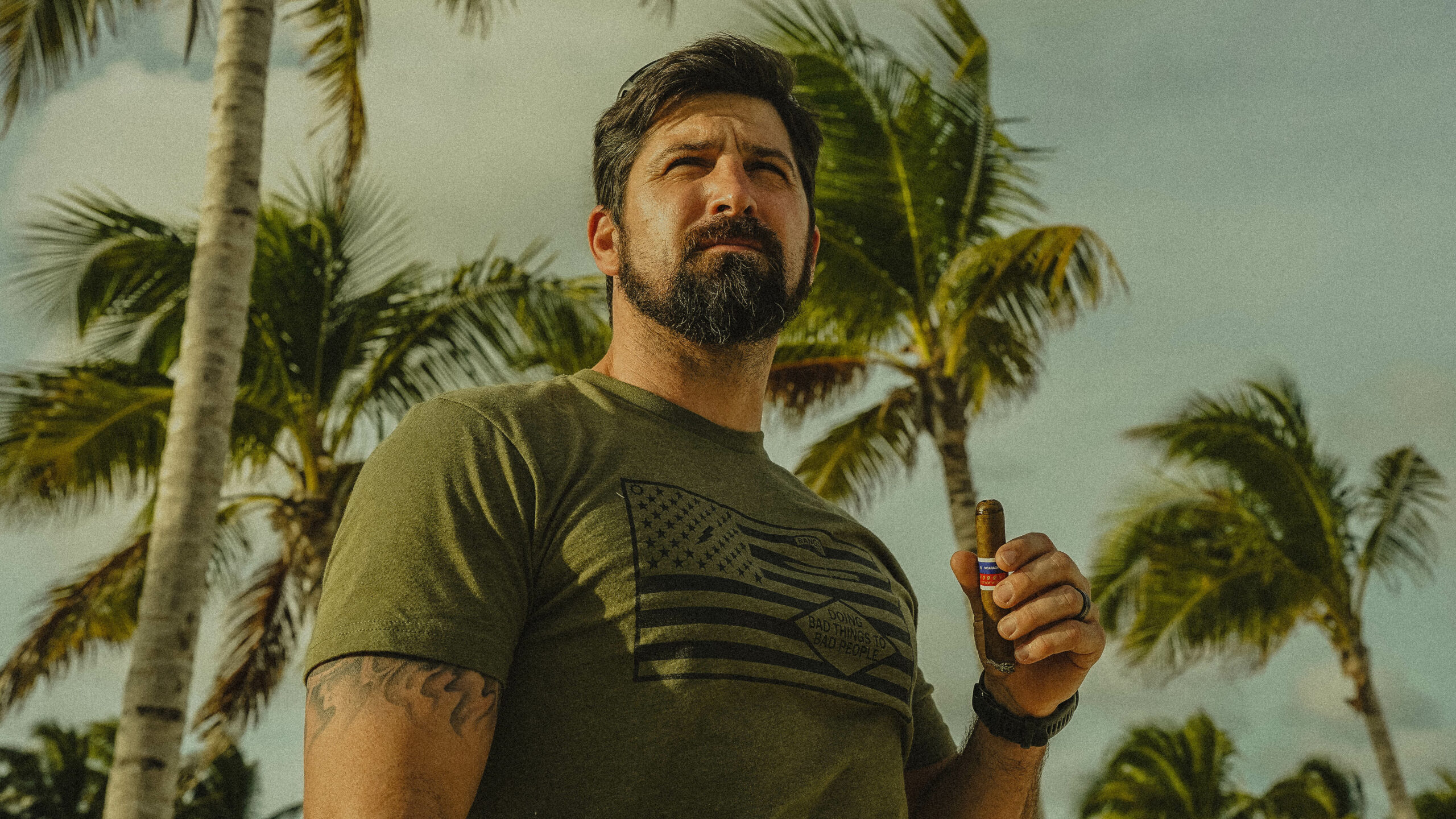
John Lovell photographed by Jack Donovan in Cancun. 2021. 

Originally published as part of the CHEST magazine project in 2021-2022. 

When John Lovell was born, he cut his own umbilical cord, backflipped off the operating table, and stuck the landing perfectly. 

That was the first thing he said when I asked him about his backstory. He didn’t miss a beat. 

John Lovell is a genuinely funny guy. I met him at a men’s think-tank that we were both invited to in Cancun this past December, and he had the entire roomful of men laughing heartily more than a few times. 

We conducted this interview on the beach, where I found John surrounded by his boys — who were hard at work crafting spherical projectiles out of sand. Mr. Lovell was working his way through some historical fiction set during the War of the Roses. After we shot the photos for this interview, he offered me a cigar. 

John is a war veteran and a former member of Special Operations, having served in the 2nd Ranger Battalion with numerous combat tours to Iraq and Afghanistan. He also spent time in Central America as a Christian missionary. 

With his business partner Evan Temple, Lovell founded the phenomenally successful Warrior Poet Society, “a values-based community dedicated to physical protection, the pursuit of truth, and living for a higher purpose.” Lovell and his collaborators offer tactical and self-defense training courses through the Warrior Poet Society brand. They also produce a range of high-quality instructional, philosophical, and entertainment content that can be found both on the Warrior Poet Society’s YouTube channel (which boasts over 1.2 million subscribers) and the WPS subscription network that Lovell has been building to combat big-tech censorship. Lovell’s Warrior Poet Supply Company also offers a wide range of branded merchandise, including innovative, patented products like his Raven Steel Target Stand — which I’ve thought about buying myself. Anyone who’s had to stop by Home Depot to pick up 1×2’s on the way out to go shooting can recognize the handy utility of having some self-supporting steel that’s always ready to go.  

An unfortunate and persistent bug in American culture tends to render the warrior and man of action as a dumb jock thug. John Lovell is pushing back against that with the name of his company itself and demonstrates through both word and deed that strong and courageous men can be and should be — and are — so much more. 

Lovell said, “I strive to be broad, but also to have depth.” He wants to be well-rounded as a man but also wants to go deep on the things that are most important to him. 

He pointed to his sons playing nearby and expressed how “critically important” it was to him to be a good father. 

“I want to make [my sons] strong because the world is dangerous. I want to make them bold because lies are all around us. I want them to be lovers because that’s where a lot of your meaning and substance comes from. I want them to be men of faith and recognize that they belong to something — or, rather, someone — greater than themselves.”

Like many men, John sees himself as a “sacred protector.” 

He says that he carries concealed everywhere he goes, not because he thinks he’ll be a likely target, but because if something went down “on his watch” and he wasn’t ready to put someone down who was hurting others, he doesn’t believe he could ever recover from that. So it is important to him that he keeps developing and practicing his skills in that area and passes on what he can to other men. 

In this way — in his own search for a balance between breadth and depth, between private and public, between emotion and reason, between being a man of the heart and a man of action — John believes that he has been on the journey of the “warrior poet” himself for a long time. And he wants to help other men along on that same journey. 

Lovell told me that he started creating and publishing content for YouTube and Instagram because he wanted to “grow with others.” He wanted to build a community of like-minded people around him and invite them to come along with him while not making things so narrow as to make their journey all about his journey. His entry points for building community with men include an agreement that “we live for a higher purpose” and that “we are willing to sacrifice in defense of others.” 

He believes that these simple principles have resonated with so many men because men who hold these ideals no longer feel represented in Hollywood or the media. 

ON FIGHTING CENSORSHIP

This brought us to the topic of censorship, which John has been very outspoken about recently. Like many of us, he believes that we are engaged in an ideological war, and last year he just “got sick of being bullied.” 

He said he no longer feels free to have his own values and ideals and be left alone. 

“The ideological opposition, the canceling, the bullying, the defaming — it’s come to my doorstep.”

To others who are facing the same sorts of censorship, Lovell says: 

“We are not in times where we can be quiet and apathetic. We actually have to go on the offense in the war of ideas if we hope to maintain a world in which our values can actually live and in which we can have free expression.”

AESTHETICS AND ENTERTAINMENT ARE IMPORTANT – BUT KEEP REALITY” REAL

A considerable part of that offensive action includes creating content and culture. And being successful at culture-creation requires us to become — however counter-intuitive it may seem to some —  entertaining.  

I’ve been trying to explain to various purists and men of ideas for years that we are all competing with Hollywood, whether we want to or not. 

John understands this well, and one of the first things I noticed about his content is that the production value is extremely high. Anyone with an eye for it can look at what Warrior Poet Society is putting out and see that someone with professional-level skill and attention to detail has thought about composition and lighting design and so many of the visual elements that we are all used to seeing and which we take for granted in the other content we consume or have consumed in the past. Quality and artistry are noticed by more people when they are absent than when they are present, but when quality and artistry are present, they confer a certain baseline of credibility. 

Lovell recognizes that, due to social media and Twitter and the persistent deluge of modern distractions, almost everyone’s attention span is “frightfully short.”

“If you want to teach anyone anything, or you want to mobilize anyone in any direction, you have to be able to somehow capture their attention. If you’re a communicator of truth or a philosopher […] you’ve got to frame that in a way that is entertaining enough that people can process it very quickly and get on board. If you’re in education, but you’re not also doing a little bit in the entertainment vein, you’re just not going to have an audience that will listen to you – much less learn and transform from you.”

John acknowledges that he’s not always the guy with the best eye for aesthetics or design, but he recognizes the importance of presentation, so he’s surrounded himself with a team of men who can help him in that area. As we were talking about it, he stopped and laughed and said:

“Here is a reality: Never judge a book by its cover. Here’s the second reality: Never think people aren’t judging the book by its cover.” 

Lovell is passionate about connecting with people in a genuine way, and he believes that they are hungry for it. 

“Social media and YouTube works because it is REAL. People are socially cut off and desperate for connection. As we’ve retreated into our phones and streaming services, we’ve lost our ability to connect with individuals in the real world. I think part of the reason folks jumped onto reality TV was that they were thirsty for those connections they weren’t getting in the real world. And then reality TV started failing years ago because it started becoming a performance, and people could feel that the “reality” wasn’t “real” anymore. So they turned to social media and YouTube, where it is still real.”

ON NICE GUYS” VS. GOOD GUYS AND THE LOSS OF COURAGE

I turned the discussion to men and asked Lovell for thoughts on some of the challenges men face today. 

“The loss of courage is the greatest tragedy we see in men today, and masculinity cannot survive it.”

“Dudes today are too focused on being “nice guys,” and I think the “nice guy” may flatter — and flattery may just be outright lying. Something might be a nice thing to say to someone, but if it is a lie, then you are exalting the idea of “niceness” over integrity. And that is a cowardly thing to do — though society really wouldn’t blame you for it.”

“If you were smashed drunk and wanted to drive home, a nice guy would let you — but I certainly won’t. You may give me a bloody nose in the process, but I’m not interested in being a nice guy. I’m interested in being a good one. In the age of tolerance, there’s no room for that superior virtue. Only with courage can we find our way out of that hole.” 


Read more

IAN STRIMBECK – NO ONE IS COMING TO SAVE YOU

Ian Strimbeck photographed by Jack Donovan. 2021. 

This interview was originally published in the CHEST magazine project in 2021-2022. 

No One is Coming To Save You.”

That’s Ian’s tagline and the motto he uses to advertise his self-defense and firearms training courses. And while self-sufficiency and self-reliance can lead to rabbit holes that become obsessions (like anything else), the idea that “no one is coming to save you” is an essential counterpoint to the assurances we receive from our aspiring overlords.

“Don’t worry about it. You’re safe. We’ll take care of everything and make sure you’re ok…”

When you say it out loud, you realize that’s how you talk to a child. Someone inside the perimeter of your protection. Someone who depends on you. 

It is the job of men to watch the outside of the perimeter and, when necessary, become the one who does the saving and be the guy on who someone else — someone less able or willing — can depend. 

We outsource this work to our own spiritual demise. 

And the truth is, in many cases, no one really is coming to save us. Law enforcement may show up on the scene, or they may merely clean up the aftermath and punish the people who did the thing that already happened to you or your loved ones. “The Doctors” may be able to help you, but they may also be corrupt or just wrong — so in the end, what happens to you is…still on you. The people who want you to believe otherwise are the people who want you to be their “children.”

Background

In Strimbeck served in the infantry in the Marine Corps from 2006-2010, including a year in Iraq and some time in the Mediterranean. After leaving the Marines, he enrolled in college and worked for an executive protection firm doing private security in Massachusetts. He started teaching firearms classes during this time and supplemented his income by doing door work at “less than desirable bars in less than desirable areas of Boston.” He says that experience “opened [his] eyes to the everyday criminal interaction and how fast and violent situations can become — especially in small and compromised spaces.” Eventually, he started his own training operation, Runenation LLC. Ian is also a purple belt in JiuJitsu. 

I met Ian for dinner with some of his firearms instructor associates at a German restaurant chain in Vancouver, Washington, several years ago. We had a fun night at Shot Show one time when a reader hooked me up with table service at a Vegas nightclub — and Ian almost had to come save me. I’ve also had him on my podcast a number of times. 

So we’ve known each other for years, but I’d never taken one of his courses, so I reached out and signed up for a Limited Signature Pistol class that he held in Utah recently. I’m a novice shooter at best, but Ian watched me work and helped me out with some suggestions and gear recommendations. 

(I picked up a Leupold DeltaPoint® Pro he recommended for my Glock)

After the course, he came to my studio, and we took some photos for this article, then reconnected remotely to conduct the remainder of this interview. 

Beyond Firearms

Ian is a firearms instructor and takes his role very seriously, but he has hard words for men who carry a gun “for clout” and also for “gun purists” who think carrying a firearm is the end-all-be-all of self-protection. He stresses that using a firearm should always be the “very last option.” There are “plenty of options that people can [and should] look into” that don’t require lethal force and which “avoid the potential post-shooting events that most people don’t want to think about” — like having your firearms seized and going through the court system.

Strimbeck believes people should be able to tap into a baseline of athleticism and grappling, and they should know how to “talk to someone on the street” and “de-escalate a potential situation.” He says that all of these things give you a sense of confidence and additional options beyond reaching for a gun. He has observed that “gun purists” tend to be some of the most insecure people because they rely solely on “that piece of metal” to protect them in what could potentially be “the worst day of their life.” 

I asked him for some resources for conflict resolution and de-escalation. Ian speaks highly of the ECQC (Extreme Close Quarters Concepts) courses conducted by former narcotics officer Craig Douglas through his company Shivworks.

He also recommends the books:

The Gift of Fear by Gavin de Becker, and 

Three Second Fighter by Geoff Thompson

We talked about situational awareness and avoiding completely unnecessary conflicts. Ian said that many “gun purists” have an overbearing sense of pride and feel that they should never have to take a different route or avoid an obvious problem waiting to happen. There are still a lot of guys who think they’re operating under cowboy rules. 

“100 or so years ago, you could draw at high noon in the town square and be done with it. But with the legalities involved in the whole system nowadays, that’s not going to work out too well.”

On Censorship

Frustrated by social media corruption and censorship, Ian created his own miniblog called Mind Fuel that people who vibe with his work can subscribe to. It’s something a little like his own Instagram — combining thoughts with the emotional power of images — but with more intention and fewer limitations. And it’s behind a low-cost paywall, so every statement and comment isn’t a public press release. 

To showcase his longer-form writing, Strimbeck created a mini-magazine project titled Discourse, where he sporadically publishes progressions of thoughts about life and training. Here’s a sample from one of his first issues:

“How can one truly know oneself if having never engaged in purpose-driven conflict?

Humans avoid what’s hard, it’s simple logic in all honesty. “Wow this shit hurts, guess I should stop doing it.” Things of great beauty usually involve some great pains. I use that analogy when people ask me why 90% of my body is covered in ink. It’s an unspoken trade-off between my artist and my body. I obtain an eternal piece of art that’s completely dependent on my pain threshold. I’ve seen grown men in shops straight up pass out like a sack of potatoes over a thumb-sized rose on their forearm. Meanwhile, I’ve seen others lay down for naps as they have an entire chest piece outlined and shaded. The same concept applies to every other facet of your life as well. The success of your business, fitness, martial arts, or shooting all correlate to your ability to withstand the storm. How close can you balance the line between your perceived limitations and death itself?”

All current and future issues of Discourse are available for a one-time subscription fee

Modern readers have been trained to think that all discourse should be free, but the true cost to the social media they consume is that they must accept the curation of an algorithm with the corporate Californian values. Writers and creators who operate beyond the cultural equivalent of Interstate 5 are always waiting for the day when some shadowy “community standards” tribunal will pull the plug on them or stifle their voices. 

Firearms and self-defense trainers like Ian are always, for obvious reasons, on the top of the not-so secret but not-quite-published “kill list.” And that makes them among the most important voices to make sure we don’t lose track of. We should all probably keep a running set of bookmarks titled “MEMORY HOLE” so that we can check in on and continue to commune with the targeted and the fallen. 

In fact, I think Ill start one now…

Ian said he believes that the only way things will change on big tech platforms is for content producers to boycott them and create alternatives. To stay true to his own values, Ian believed that he needed to create something else, and his Mind Fuel and Discourse projects have been his attempt to do that. 

On the choice between comfort and holding the line

We talked about how censorship is, by design, manipulating many people’s perception of what is going on. For instance, most people aren’t even aware of the draconian rules that the Australian government has put into place. Or the way that the Australian state has used violence to crush dissent  — actions and policies that moderate Americans would have quickly recognized as gross human rights violations before the pandemic. Likewise, many don’t even know how bad Canadians have it. The mainstream media won’t cover anything that would undermine the narrative that big tech, big pharma, and big government have conspired to promote. The powers that be don’t want average Americans to know that what is going on in Canada and Australia is “on the table” for America. Americans still own firearms, so we are frogs that must be boiled more slowly.

I asked Ian how we impress on men that it is crucial to draw a line and hold it, instead of slowly allowing the state and corporations to erode our freedoms incrementally until they exist only in theory, and then not even that.

Ian thinks that this largely comes down to a question of comfort.

“It comes down to men having that conversation with their families about what they are willing to sacrifice in order to hold the line. Men are used to having these toys…this nice truck or this nice house or these nice clothes or whatever else their routine is. There has to be a conversation — if you’re actually going to hold the line and not just talk about it — about what sacrifices you’re going to have to be willing to make in order to hold that line. Maybe you’re going to have to quit that job and get one that doesn’t pay as much. Maybe you have to sell some things or give up some things to hold true to your own morals and ethics.”

 “At the end of the day there are too many people who are willing to sacrifice true freedom for the perception of safety.”

“As men, we’ve forgotten where we’ve come from — from the days when we emerged from caves and had to beat another human to death with a rock because we wanted that piece of meat.”

Ian also believes that we have to be willing to surround ourselves with like-minded individuals who are also better than us in some way. 

“If you constantly surround yourself with people who you could potentially look up to — men of worth and purpose — then it’s going to force you to get out there and become a better individual every day.”

At some point, we will all have to decide how much autonomy we’re willing to give away, and each of us will have to choose whether we’re going to fold or if we’re going to be willing to make the sacrifices necessary to draw the line and hold it. We will have to get more comfortable with being uncomfortable and accept the possibility that “no one is coming to save us.” 

Read more

Living the Dream with Anthony “Dream” Johnson

Anthony “Dream” Johnson photographed by Jack Donovan. 2021. 

This interview was originally published as part of the CHEST magazine project in 2021. 

The man behind the 21 Convention and 21 Studios has a dream. He wants to make men (and women) great again.

Anthony “Dream” Johnson, now 33, has been running conferences to help men improve their lives since he was seventeen years old.

In 2007, Johnson was just another guy trying to learn how to talk to girls, and he made a name for himself on message boards in the pick-up artist community by posting photos and “field reports” for other young men. A lot of the PUAs used code names back then, and Anthony’s code name was “Dream.” 

At the time, the big name pick-up-artists were promoting a lot of expensive DVDs and events that were financially out of reach for most younger men, so Anthony decided to organize an “under 21” PUA convention.

He says he had no idea what he was doing, and booked the conference room with an MTV credit card marketed to college kids. The card had a $500 limit and the room was $1000. Johnson managed to attract a couple of big names on the PUA circuit to speak, and enough guys showed up with cash that he was able to cover expenses and walk with $100 profit.

It was supposed to be a one-off event, but it had a fresh energy and momentum and attendees immediately asked when the next one would be, and “The Dream” eventually responded, “same time next year.”

Anthony and the conference came of age together, and the “under 21” convention became the 21 Convention, incorporating the old name with a broader mission to help improve the lives of men in the 21st Century. The 21 Convention attracted bigger and bigger names, and Johnson has organized and hosted 21 events in Sweden, Australia, the UK, and Poland in addition to the yearly conferences in his home state of Florida.

While other content creators in the game tried to tightly control access to their videos, Anthony was inspired by the Ted Talk model, and made the professionally filmed speeches from his conferences available for free via YouTube, giving him the ability to reach millions of men around the world.

I first met Anthony when I spoke at the 21 Convention in 2017, which is also where I met the co-founder of CHEST, Tanner Guzy. I had never heard of 21 before I was invited to speak there, and had no idea what to expect. But when I arrived, I was immediately impressed by the professional production and organization of the event. In addition to the speeches, there were workshops and group outings and dinners and private after parties, and it was obvious that the Convention was also a powerful networking opportunity for men.

Since then, I’ve spoken at 21 several more times, and I even flew out just to “hang out” last year. I remember being in a hotel room when Anthony — who is a big Trump fan — broke out his first round of red “Make Women Great Again” hets. And I was at dinner with him and his longtime friend and adviser, “Socrates,” and a few others at an Indian restaurant in Warsaw when Anthony — in keeping with his mischievous nature — announced that he was going to start calling himself “President” of the Manosphere.

I’ll be speaking again at the 21 Convention this year, which has grown from an event geared toward young pick-up artists to include fitness experts and religious men and fathers and men who are interested in learning more about building strong marriages and families. Johnson loves a little controversy, also started a “22 Convention,” aimed at women, featuring mostly male speakers, which he drolly promotes as the “mansplaining event of the year.” He holds the 21 Convention, the 22 Convention, and the 21 Convention’s “Patriarchy Edition” all at the same time and in the same venue. This year’s lineup includes fitness and philosophy personality Elliot Hulse, NLP Practitioner and coach Richard Grannon, Pastor Jesse Lee Peterson, Ian Smith, “Bulldog Mindset” coach John Sonmez, Dr. Robert Glover, Psychologist Shawn T. Smith, artist Arthur Kwon Lee, coach Greg Adams, Pastor Michael Foster, writer Janice Fiamengo, and lawyer Melissa L. Isaak, and more.

To learn more about the 21 Convention or buy tickets, click here.

Last month, Anthony traveled out to visit Utah, and while he was here, we sat down in my office to talk about men and politics and life and little manosphere inside baseball, and I grabbed some quick portraits for CHEST. Then we reconnected a few weeks later over Zoom to record some quotes and get the facts straight for this interview.

ON HELPING MEN – FROM GETTING LAID TO BECOMING A FATHER

Given all of the controversy that Anthony courts with events like the 22 Convention — which landed him in a heated row with Good Morning Britain host Piers Morgan — it is easy to lose sight of the fact that he built the 21 Convention and 21 Studios to help men become better versions of themselves. Anthony believes that this is good not only for men as individuals but also crucial to America’s survival and a free and healthy society. 

I asked him for examples of men whose lives have been changed and improved through the content he facilitates, and he recalled stories familiar to us both — like men who lost 100 pounds or found a great woman. I have met some of Anthony’s younger volunteers and seen positive physical and psychological changes in them over the years as they matured, with the guidance of so many great mentors, into formidable young men in their own rights. 

But while we were talking, Anthony remembered two examples that I think showed the scope of his influence. 

Anthony remembers showing up early one morning at the 2017 conference, barely awake, and a young attendee ran toward him in the hotel hallway shouting, “Dream! Dream!” The guy told Anthony that after listening to some of the speakers and with the guidance of some of the men there, he had gone out the night before, met a woman, and lost his virginity. Anthony said that the guy was in his early twenties and that talking to women had been something he had obviously struggled with. 

“He was so excited. It was like a scene from that 80s movie Porkys or something. For a guy like that — that is such a big deal. Obviously, he didn’t learn some magic in the previous 48 hours, but we created an environment that gave him the confidence he needed at the time.”

On the far other side of the spectrum, Johnson says his longtime collaborator, Socrates — an accomplished bachelor and professional architect who has watched his evolution from his first days in the PUA scene — credits Anthony with creating an environment that made him want to settle down and have a family. Once a PUA himself, Socrates is now in a rewarding long-term relationship with a woman and became the proud father of a young girl in his late 40s.

ON HIS FIRST MARRIAGE

While the desperate Twitter script that angry women and their pocket cucks have learned by rote requires masculinity advocates like Johnson and the speakers at his conferences to be “incels,” anyone who’s spent time with Anthony or the majority of these men know that is “fake news.” The accusation says a lot more about the narcissism and hypocrisy of feminists and their pets than it does about the men themselves. 

Many of the speakers actually bring dates, girlfriends, or wives with them to the conferences, and over the years, I’ve watched a few of them walk girls out of the hotel at one or two in the morning, as the girls laugh and wave goodbye. A lot of women are intrigued and excited by these men. 

The “Dream” essentially started out in the business of getting laid — documenting his cold approaches for other PUAs at Florida events and bars and nightclubs. While, like most young men in the scene, he started just looking for sex, Anthony says he has always wanted to start a family at some point.

In his early twenties, Anthony met a nurse who was also a massage therapist. When they started dating, she compared notes with a friend and realized Anthony had been with her, too, a few nights prior. (At the time, Anthony was one of the only guys in town with a stripper pole in his apartment, so it was easy to figure out.) They continued dating, and a couple of years into the relationship, Anthony decided to marry her. He had learned a lot from men’s rights activists and was aware of how men are frequently treated in family and divorce courts, so he wisely avoided making the marriage legal. However, he wasn’t prepared for how the marriage itself played out.

After Anthony and his wife had been together for a total of four and a half years, he discovered that she had not only been cheating on him but had even been prostituting herself for extra cash the entire time the two were together. 

Anthony was shocked at the time — and embarrassed — but it makes some sense in retrospect. Anthony was a well-known pick-up artist, renting a place with a stripper pole in the living room, and he had already fucked her friend. As the marriage was ending, she confessed to him that she assumed he would cheat on her “from day one,” so she cheated on him first so that she could never truly feel cheated on. It is twisted but somewhat understandable logic in a sexual marketplace where, as Camille Paglia once wrote, there is “no law in the arena.”

So Anthony “Dream” Johnson, in his first attempt to start a family, ended up marrying a crazy hooker. I’m sure some of his critics experienced a touch of schadenfreude. Johnson later talked about the experience frankly in a 21 Convention speech titled, “Marrying Medusa: How to Survive a Female Psychopath.”

After an expected period of bitterness, Johnson returned to his life of sexual adventuring and discovered that while he’d been married, the bar scene had moved online to apps like Tinder and Bumble. Johnson mastered these forms quickly and spent several years banging “the hottest girls he could find.” He said that every year his exploits got “a little wilder,” and he kept pushing the envelope to see how fast he could hook up with a hot girl or if he could fuck a “sugar baby” (a sexually attractive young woman who works older men for money and gifts) for free. 

“I felt like Batman,” he said, because he was “turning the tables” on all of these women who were scamming other men. 

ON VOLUNTARY CELIBACY

However, because his long-term goal has always been to build a family, Anthony told me that a few months ago, he decided to stop having sex with women until he finds a woman he wants to marry and have children with. 

Anthony “Dream” Johnson, pick-up artist extraordinaire, became voluntarily celibate. 

He says there were a lot of factors involved. To begin, he realized that he was putting himself in increasingly dangerous situations and that, sooner or later, he was going to end up dealing with an unwanted pregnancy or an STD that you can’t get rid of with a quick trip to the doctor. He realized that his life as a public figure would make him a target for some kind of #metoo entrapment or shakedown. 

Johnson was also deeply affected by the birth of his sisters’ children.

“Just holding a baby that’s in your own bloodline — or close enough — that was a major gut-check for me.” 

He said, “It made me re-examine some of the bolder statements from speakers like Elliot Hulse,” who told him that “the next woman you fuck needs to be your wife.” 

When you’re a dude on Tinder banging hot chicks and raw-dogging them and giving them Plan B — or anything even approaching that — this just goes in one ear and out the other.”

Most of the men who had given him advice about marriage and family were religious, and Anthony has always been an atheist. His challenge was the challenge that many non-believers face. He had to find his own reasons. 

“I think that’s what happens to a lot of young Americans today. They develop, in my view, a completely rational skepticism [about] a supernatural being controlling everything in the world. And then the minute you remove that faith in a higher power, all of these other elements fall apart.”

However, while holding his nephews, he found himself thinking…

“…when I have kids, they’re going to be this baby’s cousins. If I choose the wrong mother […] I know what I am going to be stuck with personally because I’ve seen guys in the manosphere go through this — family court, alimony, child support, crazy abusive women who lie to psychologists, lie to attorneys, lie to judges — it’s a fucking nightmare for these guys, and I’ve seen it firsthand and I know their kids sometimes. I see how toxic it is in real life and I see the bullet I dodged with my ex-wife, the ‘hooker-nurse.’ If I fuck this up it isn’t only going to be bad for me for eighteen years — minimum — it’s going to be bad for this kid for the next 30, 40, 50, 60 years…until that woman dies. And that kid will have to suffer from that choice of mine — to bust a nut in this chick, literally, for their entire life.”

It’s heavy stuff. Anthony said that he realized that if he wanted to build a strong, healthy family, the life he was living would jeopardize that. He realized that all of the precautionary measures he could take — whether condoms or Plan B or whatever — were all still risky. He decided the only sure way to protect his future and the future of the children he wants was to become abstinent. He also wondered whether, having had sex with over 130 women already, he might eventually lose the ability to pair bond at all. 

So, for Johnson, there is no concern about God or sin. It eventually came down to rational long-term thinking based on his own goals and values. 

Until he finds a woman he wants to be the mother of his children, Anthony plans to remain celibate. 

OBJECTIVISM

Reason is an important part of Anthony’s worldview. He considers himself an Objectivist and is very passionate about the philosophy. 

While we were driving out to see The Great Salt Lake, I asked him about it. I told him I thought that a lot of people would be surprised to know that the President of the Manosphere’s philosophy is based on the work of a woman — Ayn Rand. 

This gave him a chuckle, but he explained that his personal theory was that Ayn Rand, as a woman, wanted to understand reason and get closer to it. So she stepped outside of herself and tried to figure out how the most rational and objective person would think and behave. 

And, notably, she made the characters that embody her rational philosophy…men. 

A REVOLUTION IN MASCULINITY

I asked Anthony how he thinks the men’s movement and his work organizing conferences fits into the bigger picture of what is going on in the world today. 

He said that while many of us realize that we’re living in what he called “an Alex Jones world” of medical and state tyranny, where ideas like vaccination passports, “green zone” detention camps, bans on interstate travel, and all kinds of other restrictions on speech and freedom are being openly advocated and in some instances, actually implemented — even if some sort of “1776” style revolution were to happen and be successful — he wonders what would change in the end, unless there is a massive cultural change to go with it. 

“The culture is so emasculated and so weak and so pussified, and the problems are so much bigger than politics, it wouldn’t really solve anything long-term.” 

“We need a revolution in masculinity and in femininity. Men need to act like men, and women need to act like women. We need a return to common sense, like our Founding Fathers talked about, but a return to common sense masculinity and common sense femininity and common sense family values…where men are not fucked over in divorce court, where men are not losing 86% of custody battles […] children suffer from this. Men suffer from this. Men commit suicide at crazy rates. We need a revolution in masculinity, and from that, we can move culture. And the men’s movement is the only group of people talking about doing that.”

“Political conservatism is ‘Boomer conservatism’ — they are doing jack shit. They give a little bit of lip service to family values, and it is doing nothing. The Christians have all been cucked. Their patriarchal religion has all been cucked. Even Mormons have feminists. The only thing left is the Amish, who are ‘pure.” The problems we’re facing are ‘fall of Rome’-level serious, and I don’t see a solution other than a revolution in culture, which starts with masculinity and femininity. And that’s where my work, I think, impacts things in a major way. […] It’s not my ideas driving this. It’s my organizational ability to find guys like you and Tanner and Elliot and bring them together in a way that has real power to it. Our Founding Fathers had conventions, and look where that fucking went.”

Anthony and I agree that feminism is one of the most significant cultural shifts in human organization that the world has ever seen — and the fallout from that abrupt change has been and continues to be catastrophic. 

“Masculinity and femininity are the oldest forces in our species. They precede civilization, they precede fire, maybe they precede even language. […] These forces are fucking huge. It’s not just sex — which is the meeting of femininity and masculinity in terms of breeding and continuing the species. It comes down to ‘what is it to be masculine and what is it to be feminine and what are the consequences of disobeying nature. And those consequences [in this case] are the fall of your country.”

I’ve known Anthony for several years, and while he is absolutely a provocateur who loves to troll people and push their buttons, I believe that he is completely sincere. He’s not just out to make a buck — there are easier ways to do that. 

For fifteen years, Anthony “Dream” Johnson has been working to improve the lives of men and improve their situation in the world. He’s a man who is trying to do something he believes is good and necessary and right. He’s a “Florida Man” who believes in freedom and the founding principles of the United States, and he is on a mission to make men (and women) great again.

Read more

ELLIOT HULSE IS MAKING MEN STRONG AGAIN

Elliot Hulse, photographed by Jack Donovan. 2021. 

This interview was originally published in the CHEST magazine project in 2022. 

Elliot Hulse made a name for himself when he opened his first Strength Camp gym and started promoting strongman-style strength training on YouTube in 2007.

Since then, strongman competitions have grown and become more popular. I remember being interested in strongman training myself around that time — back when I was delivering exercise equipment — and there were far fewer resources available. You could mail-order some molds for making cement stones, or get ideas from books that became classics in the genre like Dinosaur Training from Brooks D. Kubik. Strongman training at that time was kind of a fringe, DIY subculture for men.

Strongman training reaches back to the primal roots of strength training — back before everything seemed to revolve around dumbbells and barbells, and long before exercise machines as we know them today were even a twinkle in anyone’s eye.

You can imagine a group of guys in Ancient Greece or in Scotland, or just a bunch of cavemen standing around shooting the breeze.

“I bet I can lift that big rock.”

“I bet I can lift that rock and carry it father than you.”

“Well, I bet I can lift that log over my head.”

And they did, and there’s evidence of traditions like stone and log lifting all around the world.

One can imagine that the guy who lost the bet went out into the woods every day for the next six weeks and lifted that stone or that log over and over again until he knew he could beat some of the other guys in the next competition. Perhaps that is the true and natural genesis of strength training.

A lot of young men were and are hungry for that kind of primal physical experience. Hulse tapped into that because it was something he enjoyed and excelled at doing, and over time he found himself becoming a kind of mentor and father figure within that growing community of men.

Over several years, his YouTube channel blew up to over a million subscribers, and a lot of what he found himself doing was answering questions about fitness, but also about life and philosophy.

Hulse told me that one of the things he really enjoyed doing at his gym was hanging out with the young men at his gym after their workouts.

“They asked me questions, because they trusted me, about life, relationships, careers, family, and things of [that] nature. And apparently, they benefitted greatly from hearing my insights on things outside the gym.”

So he started a second YouTube channel devoted to answering questions about life outside the gym, and that also gained almost a million subscribers.

“And now, here I am sitting as a washed-up old strongman strength coach who posits as a father figure to perhaps millions of men worldwide.”

Hulse is a big personality online. High energy and right up in your face. I remember hoping that he wasn’t that way in person. I met Elliott for the first time at the 21 Convention in 2019. That online personality is obviously part of who he is, and when you get him started talking about something about which he is passionate — you definitely get that energy and authority. But Hulse is also polite and pensive and generous. He has mature, grounded confidence. He’s not the kind of guy who has to “big-dog” a whole room.

I snapped the photos for this article quickly in the “green room” at the 21 Convention in 2021. Hulse was in “guru mode” when I met him in 2019. But in 2021, he was looking bigger in preparation for his first strongman competition in years. His presence was stylish and athletic, and his wife was at the conference with him. I’ll also say that I thought Hulse appeared to be especially…happy. I reached out to him in early 2022 to conduct the actual interview for this article online.

The Joy of Being a Brute

Hulse got into strongman training — and eventually competing, coaching, and YouTube — because he played football in high school and college and learned that he really enjoyed “smashing heads.”

“It was such a joy to be a brute!”

“That’s what I’m built to do. I’m like a Mack truck. I like to smash myself and smash into things.”

When that came to an end, Hulse said he felt a little lost for a while, until he discovered strongman training and eventually got his pro card in 2010. Strongman is a little less predictable than sets and reps under a bar, and Hulse thinks his YouTube audience grew because he was always doing something different — flipping tires one day and pulling a truck the next.

He kept filming and competing and winning until he popped his bicep and stopped competing. That’s when Hulse decided he could make a bigger impact by going “all-in” on the Internet.

The Mid-Life Opportunity

Between age 30 and 40, Hulse said he was busy building a family and a brand and a business, but around 40, he stopped to re-evaluate.

“They like to call it a mid-life crisis, and maybe it is in a way, but it is also an opportunity to take a look at your life. I took a look at my life from a helicopter view, and had to come to peace with the things that weren’t going to be, and I had to be realistic about the things that I am called to be. So I revived my love for lifting again. I can do it. It’s a gift. Why not exercise the gifts God gave me? So I decided to go back into strongman training and I competed last year for the first time as one of the “masters” — that’s what they call the old guys.”

Elliott said he was nervous about competing again after so many years, and at 5’9”/220#, he found himself surrounded once again by much larger men. But he said he “wiped the floor with them” and “zipped through everything” and figured “this is what I am supposed to be doing.”

Hulse thinks he’s going to continue competing in strongman, perhaps once a year.

“I want to be OLD. I want to have gray hair and a big, long beard and still be jacked and lifting stones.”

Hulse has a collection of atlas stones ranging from 100 pounds to 300 pounds, but he says there is one right in the middle — a 220-pound stone — that he has his eye on.

“Well into my old age, maybe 80-year-old Elliott, I want to be able to pick up that stone and put it on my shoulder.”

On Becoming a Leader of Men

We talked about his evolution from being a strength coach into becoming a leader of men, and the responsibility that comes with that. Hulse said that he got carried away with it for a while and convinced himself that he was changing men’s lives — which he absolutely does — and changing the world. But eventually, he felt that he was becoming prideful and needed to humble himself, and he wanted to make it clear that, at the end of the day, he’s just a man.

“I give my opinion on stuff. That’s what I do.”

Hulse also felt the weight and the responsibility that comes with being a leader, and he wants to make sure he’s leading men in the right direction.

“When I die, it’s true that God’ is going to judge me, and he’s going to say, ‘Look, you had all these guys — and THIS is where you led them?”

“We are suffering as a people because men are weak, men have been feminized, men have been subverted in their powers in the home and in the world.”

Hulse explained that because of this dire situation, the sentiment that motivates his work of “answering questions and giving opinions” is his belief that we can only restore what is lacking in the world today by “making men strong again.”

Estranged from Our Own Nature

I asked him what problems he encounters most with younger men, but he made the point that so much of the confusion he sees in young men today is a consequence of the breakdown of the family. They’re confused because their fathers weren’t present, or they were effeminate or incompetent. He attributes this to the proliferation of communist ideology in the West after the Bolshevik revolution. “If you want to break down the power structures in the home, you make women hate men.”

While men are often accused of misogyny, Hulse said he doesn’t see a lot of it out there. He admits that there are some angry men — some of them justifiably angry about what has been done to the family and the country — but Hulse believes that we see far more misandry than true misogyny in the world today.

“We’re living in a matriarchal world, where men are trained to think in a gynocentric, pro-feminist way — which, number one, is not attractive to women at all. It destroys relationships, it destroys the authority structure that is important to any organization”

“Men are so estranged from our own nature.”

Hulse credits much of his understanding of this to having been lucky enough to grow up with an “alpha male dad.” Elliott’s father is from Belize and he “grew up in the jungle.” His father grew up around manly men who “climbed trees and killed things.” Elliot’s father wasn’t indoctrinated in the school systems with “all the garbage that keeps us weak.” Elliott was, however, and when he was younger, he said that he resented his father and thought he was some kind of caveman.

Hulse said he couldn’t relate to his father or really understand him until he was in his late twenties or early thirties. He slowly started to realize that, “I and everyone else had this backwards, and my dad’s been right the entire time.”

“Some people said I had become toxic, but really, I’ve atoned with my father and recognized who I really am, and this is what the world needs: strong fathers.”

On Raising Daughters

Elliott Hulse has one son, but he also has three daughters, and he had some thoughts about raising daughters in our upside-down world with a patriarchal mindset, “without making them hate me.” He told me that he prides himself on creating an environment where his daughters can learn to be like their mother, who he described as a great wife and a great mother to her children.

Elliott chuckled and told me that he has some selfish motives involved in his work with young men. “There’s no way I’m going to send my daughters off with any of these weak, weird men.”

Hulse says part of what he is doing is “planting seeds” in a generation of men, so that hopefully some of them will make good husbands for his daughters.

He also observed that so many alpha male men, “raise their daughters to compete with men. So they raise their daughters to be alpha women. They’re doing a total disservice to men. by teaching your daughter that “you don’t need any man.”

“Hold on buddy. That’s not your son. You want to do us a favor here by allowing your daughter to be feminine. Especially in a world that’s so anti-sexual polarity — because it’s anti-male and it’s anti-female. As much as it is gynocentric, it’s not feminine. It’s a perverted form of female nature that they’re promoting. And so, if we’re going to get this all right, it can’t just be us men making men strong, somebody, somewhere, at some point has to make these women wife-worthy.”

I asked him about some of the challenges he’s encountered in the process of raising daughters, and he said that the primary challenge was dealing with the prevailing culture.

“Everywhere you look, every movie you watch, every series on Netflix, every song you hear sung, everywhere you look — it’s feminists and feminism. It’s teaching men how to be effeminate and teaching women how to be feminists.”

Hulse explained that part of the problem is the way that people from the 1960s forward have been trained to see generations laterally instead of vertically — identifying primarily with their same-age peers instead of their parents, ancestors, and extended families.

“Children feel the need to separate themselves from the vertical integration of the family. There was a time before this idea of “generations” when a son would want to behave more like his father and grandfather because there was wisdom there. Now it is a matter of ‘this is what my friends are doing, this is what the movies are doing, this is the Zeitgeist is all about — and my parents are dumb.’”

He says his strategy for combatting all of the ideological propaganda slipped into cartoons and entertainment and the attempts to turn children against their parents is to point it out immediately when he sees it, and talk about it with them.

“A lot of dads leave the raising of their daughters up to their mothers. We don’t know what to do — they don’t even know how to be men, so they don’t want to interfere with these girls. But we need to be able to understand the enemy and point it out to our children. I would hear my daughter say certain things — and I’d say ‘whoah, I know you heard that on a YouTube video and that’s what your friends are saying, but you have to understand that that’s not realistic and you have to understand that is in fact a form of ideological subversion meant to destroy your psyche and your soul and ultimately your life because that doesn’t work in a family.”

“With my daughters especially, I plant the seed that family is the most important thing that you will achieve in your life.”

He noted that they also see bad examples in their friends’ homes, and he believes it’s important to point that out, too.

We ended our discussion with some shop talk about censorship. Hulse says he’s been banned and shadow-banned and de-monetized on several platforms. But he said he realizes that the idea that we get to use these platforms and advertising channels for free to disseminate our messages is fairly new. People always had to “pay to play,” and he is working on investing in other channels and outlets so that, no matter what happens, he can keep making men strong.

Read more